01
Open and inspect the collection materials
Check the supplied container, collection device, packaging, labels and instructions before starting. If something appears missing, damaged or unclear, resolve that question first.

A stool microbiome test uses a collected stool sample to explore microbiome-related information. The quality of the experience starts before laboratory processing: careful collection, avoiding obvious contamination, correct packaging and realistic expectations all matter.

Read the complete kit directions before collecting anything. You should know which materials are required, how the sample is transferred, what must be labelled and how it will be returned before you begin.
If your goal is broader product information rather than the stool-collection process, visit the gut microbiome test in Canada page.
Check the supplied container, collection device, packaging, labels and instructions before starting. If something appears missing, damaged or unclear, resolve that question first.
Avoid obvious contamination during collection. The instructions supplied with your test are the authority for how the specimen should be collected and transferred.
More sample is not automatically better. Use the amount and collection technique specified by the kit rather than guessing based on another stool test or online tutorial.
Complete the required labelling, sealing and packaging while the instructions are in front of you so an avoidable step is less likely to be missed.
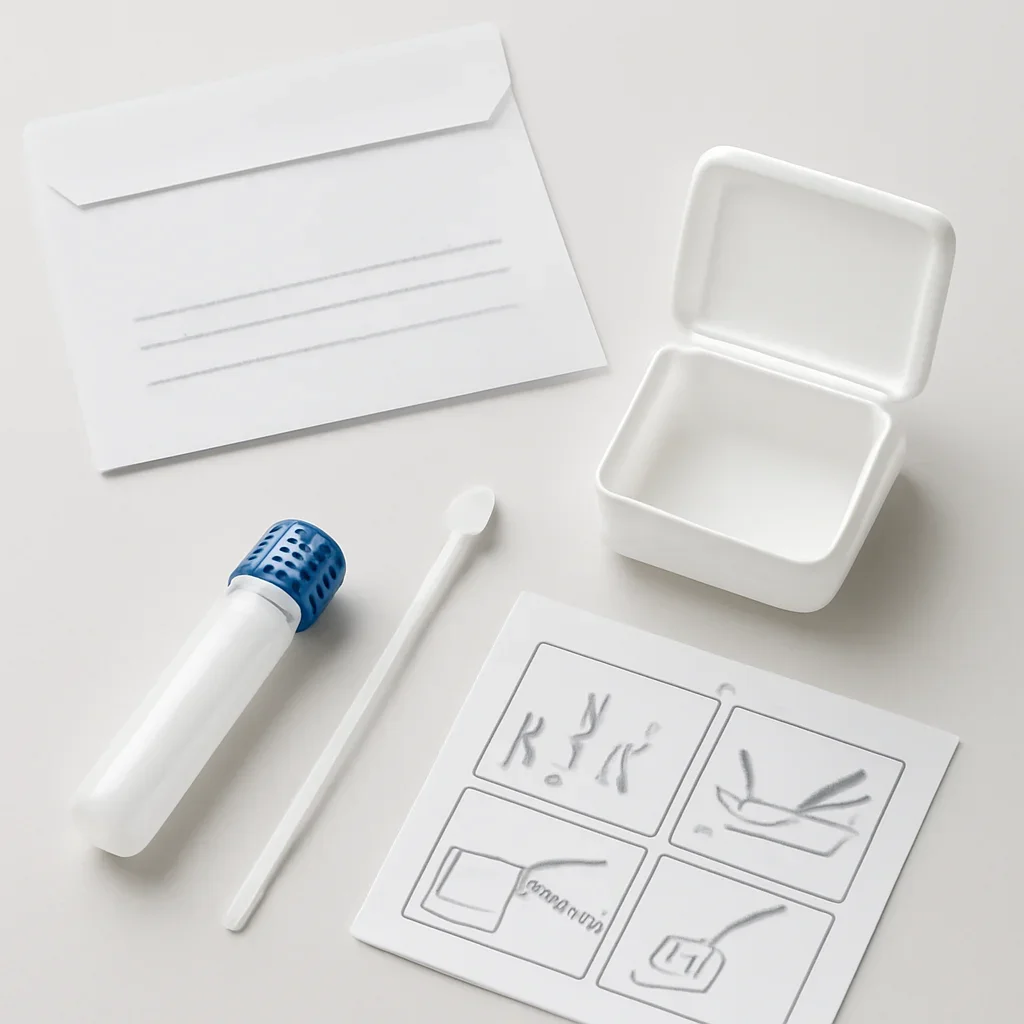
Stool testing depends on the sample that reaches the laboratory. That makes basic collection hygiene important. General Canadian stool-sample guidance recommends keeping specimens away from toilet water, cleaning products, soap, toilet paper and urine.
Kit instructions come first. Guidance for hospital, physician-ordered or other stool tests may use different containers, timing or handling requirements. Do not substitute another test's instructions for those supplied with your microbiome kit.
Stool collection is more than an inconvenient step before the "real" test. The submitted specimen is the material used for the subsequent laboratory and reporting workflow, so collection, identification and packaging deserve careful attention.
Avoid introducing unrelated material during collection. Contamination can make the submitted specimen less representative of what you intended to collect.
Follow the supplied registration or labelling process carefully. A sample must be connected to the correct order and workflow before meaningful reporting can occur.
Use the supplied or specified protective packaging and follow the return directions rather than creating your own shipping arrangement for the biological sample.
Think of the return as a chain. Collection is complete only when you have followed the identification, packaging and return steps provided for the test.
Transfer the required stool specimen according to the directions supplied with your individual kit.
Complete the applicable registration, identification or labelling requirements before sealing the return package.
Secure the specimen using the materials and arrangement specified in the instructions.
Use the return pathway provided for the order and keep applicable shipment information for your records.
This page deliberately avoids naming a specific sequencing platform, assay, database or laboratory certification unless current provider documentation confirms it. Different microbiome methods can produce different kinds of information and should not be treated as interchangeable.
The returned stool sample goes through the applicable laboratory processing and reporting workflow for the selected microbiome test. The resulting report organizes microbiome-related findings according to that test's scope and reporting framework.
Details such as the exact technology, depth of analysis and database used should come from current laboratory or provider documentation, not assumptions.
Collection, laboratory methods, bioinformatics and reporting choices can influence what a microbiome report detects and how findings are organized.
That is why "advanced," "comprehensive" or similar marketing terms should never replace a clear description of what the test actually analyzes and what limitations apply.
Report contents depend on the selected testing and reporting method. The useful question is not simply how many organisms are listed, but how clearly the findings and their limitations are explained.
A report may organize microbial groups detected within the scope of the analyzed stool specimen and selected test.
Relative or composition information may be used to show how reported microbial groups are represented within the sample.
Where included, diversity metrics need context. A single diversity number should not be treated as a universal score of digestive health or disease risk.
Plain-language explanations can help connect technical report sections with their intended meaning and the uncertainty that remains around consumer microbiome interpretation.
A submitted specimen represents material recovered from that particular stool sample at that particular time. It should not be interpreted as a complete map of every microbial community throughout your digestive tract.
Microbiome science is still developing, and an association in a research study does not automatically prove that one organism is causing a person's symptom or health condition.
The sample can provide microbiome-related information within the scope of the selected test and reporting method.
It cannot establish that a reported microorganism is the cause of a digestive symptom.
It should not be used by itself to diagnose or rule out IBS, IBD, infection, food allergy or another medical condition.
It does not replace physician-ordered stool testing or another clinical investigation selected for a specific medical question.
Persistent, worsening or otherwise concerning digestive symptoms belong with a regulated healthcare professional rather than a consumer report alone.
The answer depends on what you are trying to learn. This page addresses consumer microbiome testing, not clinical stool testing ordered to investigate a specific disease or infection.
| Your goal | Consumer stool microbiome report | Better next step when needed |
|---|---|---|
| Explore microbiome information | May fit when you want educational information about the submitted stool sample and understand the limitations. | Preview the actual report and test scope before purchasing. |
| Understand a persistent symptom | Should not be treated as proof of the cause. | Discuss persistent or worsening symptoms with a regulated healthcare professional. |
| Diagnose an infection | A consumer microbiome report is not a substitute for diagnostic testing. | Seek appropriate clinical assessment and testing. |
| Change prescribed treatment | Do not use the report alone to stop or change prescribed care. | Discuss treatment decisions with the prescribing or appropriate healthcare professional. |
| Track general microbiome information | A report can provide a dated informational snapshot when the same test and context are understood. | Avoid treating movement in one metric as proof that health has improved or worsened. |
Before submitting personal details and a biological sample, review what information is requested, why it is used, how report access works and where privacy or consent questions can be directed.
Collection guidance should distinguish verified kit instructions from general stool-sample information. Laboratory claims should likewise be tied to current provider documentation rather than inferred from unrelated microbiome tests.
The published page should be rechecked whenever collection materials, return procedures, laboratory documentation or reporting language changes.
These answers focus on the stool specimen itself, collection quality, laboratory context and responsible interpretation.
A stool microbiome test uses a small stool sample collected with the materials provided for the selected kit. Review all kit-specific directions before starting because the required amount, collection device, labelling, packaging and handling instructions can vary. General online collection advice should never replace the instructions supplied with your individual test.
Start with the instructions supplied with your kit. As a general stool-collection hygiene principle, keep the sample away from toilet water, cleaning products, soap, toilet paper and urine unless your specific instructions say otherwise. Wash your hands thoroughly after handling collection materials and contact support before collecting if any instruction is unclear.
Use only the amount specified in the instructions supplied with your microbiome kit. The required quantity can depend on the collection device and laboratory workflow, so this page does not provide a universal measurement. Collecting more than instructed is not necessarily better and could interfere with proper packaging or handling.
The returned sample must reach the appropriate laboratory and be accepted for processing. Laboratory and reporting procedures are then used to analyze and organize microbiome-related findings for the selected test. The exact methodology should be confirmed from current provider documentation rather than assumed from general microbiome-testing descriptions.
No. A consumer stool microbiome report should not be used by itself to diagnose or rule out IBS, IBD, infection or another medical condition. A healthcare professional may use symptoms, history, examination findings and appropriate clinical tests when investigating illness. Seek professional assessment when your concern is medical rather than educational.
Do not stop prescribed medication or make major treatment decisions solely because of a consumer microbiome report. Diet-related information should also be considered in context rather than treated as proof that a particular food is causing symptoms. Discuss medical or significant dietary changes with an appropriately regulated healthcare professional.
No. A submitted stool sample is a snapshot of material recovered from that specimen at that time. Collection, laboratory and reporting choices can influence what is detected and how findings are described. Microbiome patterns can also vary, so one consumer report should not be treated as a permanent score of gut health.
Know what you will need to collect, how contamination is reduced, how the specimen is returned and what the eventual report can—and cannot—tell you before committing to a kit.
