
What Should You Eat Before a Microbiome Test?
For most people, the useful goal before a gut microbiome test is not to eat a “perfect” diet for a day or two. It is to collect a sample that reflects the routine you actually want to understand. Always follow the instructions supplied with your specific test kit first.
Unless your kit gives specific food or fasting instructions, avoid inventing a last-minute microbiome diet. Eat in a way that is reasonably representative of your usual routine, do not suddenly load up on fibre, fermented foods or supplements just to influence the result, and do not stop prescribed medication for a consumer test without guidance from the clinician who manages it.
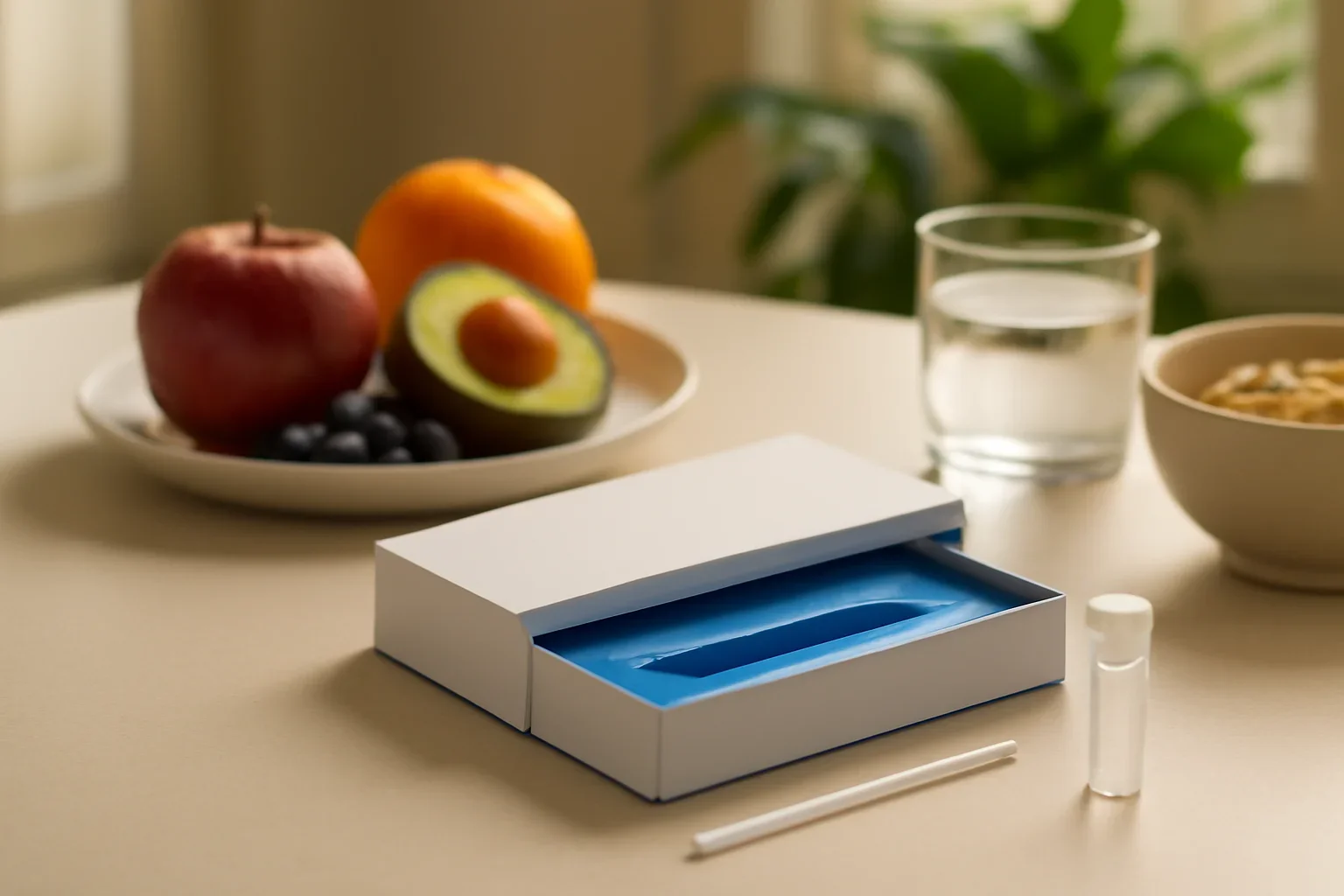
What to do with food before collecting your microbiome sample
The exact instructions depend on the test you ordered. These four principles help keep preparation sensible without creating a false “cleanse” or a diet designed to produce a particular-looking result.
Keep your normal eating pattern recognizable
If the purpose is a snapshot of your usual routine, a sudden diet overhaul just before collection works against that goal.
Follow the kit instructions first
If your selected test specifies timing, fasting, foods, supplements, storage or collection requirements, those product-specific directions take priority.
Record major recent changes
A major diet change, recent antibiotics, gastrointestinal illness or travel can provide important context when you later interpret a time-specific result.
Do not change medical treatment for the test
Do not stop or delay prescribed medication simply to alter a consumer microbiome result. Clinical treatment decisions belong with the appropriate healthcare professional.
A special pre-test diet can change the thing you are trying to measure
The gut microbiome is responsive to diet. Human controlled-feeding research has detected changes in microbial composition within about 24 hours of a substantial dietary change, and another short-term intervention found rapid changes when participants switched to entirely animal-based or plant-based diets.
That does not mean an ordinary breakfast will invalidate a microbiome test. It means that deliberately eating very differently from normal immediately before collection can make the sample less representative of the routine you intended to examine.
- check_circle Do not “eat extra healthy” for one day just to try to improve the report.
- check_circle Do not deliberately overload on fermented foods, fibre or prebiotic foods unless that is your normal pattern or part of a planned comparison.
- check_circle If you recently changed your diet substantially, record when that change began.
What should you eat the day before and the day of a microbiome test?
There is no universal pre-test menu that applies to every commercial microbiome kit. The useful default is to avoid unnecessary changes and follow the instructions for the specific product you purchased.
Keep meals reasonably representative of your routine
- check_circle Eat foods you commonly eat rather than creating a one-day “microbiome menu.”
- check_circle Do not suddenly start a high-fibre, low-fibre, fermented-food-heavy or restrictive diet solely for the sample.
- check_circle Review the collection instructions before you need to use the kit.
Use the kit directions rather than a generic internet rule
- check_circle Follow any product-specific timing or fasting instructions if they exist.
- check_circle Collect, package and store the sample exactly as instructed.
- check_circle Confirm return-shipping steps before collection so the logistics do not become an afterthought.
About fasting: do not assume you must fast just because some blood tests require fasting. Stool microbiome tests have their own collection protocols. Use the instructions for your exact kit.
Research shows the gut microbiome can respond quickly to diet
This is the reason preparation advice should avoid pretending food is irrelevant while also avoiding the opposite mistake of prescribing a special “microbiome test diet.”
Detectable changes within about 24 hours
In a controlled-feeding study reported in Science, the gut microbiome composition of participants changed detectably within 24 hours after starting either a high-fat/low-fibre or low-fat/high-fibre diet. Broader enterotype classification remained stable during the short intervention.
Wu GD et al., Science (2011). View study
Rapid response to major short-term dietary change
A separate human study published in Nature found rapid, reproducible changes in microbial community structure and activity when participants switched to diets composed entirely of animal products or plant products.
David LA et al., Nature (2014). View study
Practical takeaway: a last-minute dietary experiment can alter the biological context of the sample. If the goal is to understand your usual pattern, keep the collection period reasonably representative of that pattern.
What about fibre, fermented foods, coffee and supplements?
The safest general rule is not to add or remove a major part of your routine simply because collection is approaching. Product-specific instructions still take priority.
Fibre-rich foods
If oats, legumes, vegetables, fruit, whole grains, nuts or seeds are part of your normal diet, there is no reason to create an unusually high- or low-fibre day just to influence the sample unless your kit specifically directs you otherwise.
Yogurt, kefir and fermented foods
If fermented foods are already part of your routine, keep the goal of a representative snapshot in mind. Do not suddenly start consuming large amounts solely because a microbiome collection is scheduled.
Coffee and everyday beverages
Avoid creating a new restriction based on generic online advice. If the kit has beverage or timing instructions, follow them; otherwise your usual routine is the more relevant context for a routine snapshot.
Probiotic or prebiotic supplements
Supplement instructions vary by product and test. Check the kit directions and avoid making a new supplement change solely to manipulate the report.
Restrictive diets
Do not start a restrictive diet solely for microbiome testing. If you already follow one for medical, cultural, ethical or personal reasons, that existing pattern is part of the context of your sample.
Recent major diet change
If you recently shifted your eating pattern substantially, record the timing. That history may be more useful when reading the report than trying to “normalize” your diet for one or two days before collection.
Preparation in Canada is partly about food—and partly about logistics
Your microbiome sample reflects biology at collection time, but at-home testing also involves shipping and return logistics. If you are outside a major urban centre, ordering around a holiday, or planning a before-and-after comparison, read the current shipping instructions before you choose the collection date.
There is no reason to replace your usual Canadian eating pattern with an imported “microbiome diet.” Health Canada’s current dietary guidance emphasizes regular variety across vegetables and fruit, whole grains and protein foods, with plant-based protein foods more often. That is general healthy-eating guidance—not a required microbiome-test preparation protocol.
Before choosing your collection day
Preparation should make the sample easier to interpret—not turn collection into a short-term performance designed to produce a “better” result.
Recent changes worth noting before a microbiome test
Some circumstances can make the sample less representative of your long-term routine. That does not automatically mean the test is unusable, but it may change how you interpret the timing.
Useful context to record
- check_circle A substantial diet change and when it began
- check_circle Recent antibiotic exposure or other major medication changes
- check_circle Recent gastrointestinal illness
- check_circle Major travel or temporary disruption to your normal routine
Do not make these decisions just to change a test
- block Do not stop prescribed antibiotics or other medication without appropriate clinical advice.
- block Do not start a restrictive or extreme diet solely for the collection.
- block Do not treat a consumer report as the answer to unexplained or concerning symptoms.
- block Do not assume a more “diverse” or different result automatically means better health.
A clearer four-step path before you collect a sample
This keeps preparation focused on the quality and meaning of the snapshot instead of adding unnecessary food rules.
Know what you want to learn
Decide whether you want a snapshot of your usual routine or a planned comparison around a diet or lifestyle change.
Read the exact kit directions
Check food, fasting, supplement, timing, storage and return instructions before the collection day rather than relying on a generic article alone.
Keep the routine representative
Unless your kit says otherwise, avoid creating a last-minute diet that is unlike the way you normally eat.
Preview how results are reported
Look at the sample report before ordering or collecting so you know which measurements and educational explanations you will actually receive.
Related microbiome preparation and testing guides
These pages answer the next layer of questions without repeating this page’s food-before-testing intent.
How to Prepare for a Microbiome Test
Review the broader preparation process, including practical collection, timing and pre-test questions beyond food alone.
Read the preparation guide arrow_forwardFoods for the Gut Microbiome
Read the broader diet guide when your question is about everyday fibre, plant variety and foods rather than immediate pre-test preparation.
Read the food guide arrow_forwardMicrobiome Testing for Beginners
Start here if you want a plain-language explanation of what testing measures, how at-home collection works and what a report cannot diagnose.
Read the beginner's guide arrow_forwardScience Behind Microbiome Testing
Review scientific context, laboratory concepts and limitations that matter when interpreting a consumer microbiome result.
Review the science arrow_forwardGut Microbiome Test Canada
Review the main Canadian gut microbiome test page, including at-home stool collection and the information to check before ordering.
Explore the gut test arrow_forwardMicrobiome Test Results
Learn how to approach report sections, time-specific findings and educational interpretation after your sample has been analyzed.
Understand test results arrow_forwardSources used for this guide
The preparation advice on this page is deliberately conservative: product-specific collection instructions come first, while human diet-microbiome research is used to explain why a dramatic last-minute change may alter the biological context of a stool sample.
- Wu GD, et al. Linking Long-Term Dietary Patterns with Gut Microbial Enterotypes. Science. 2011;334(6052):105-108. DOI
- David LA, et al. Diet rapidly and reproducibly alters the human gut microbiome. Nature. 2014;505:559-563. DOI
- Health Canada. Canada's Dietary Guidelines: Healthy eating recommendations. Current guidance emphasizes a variety of vegetables and fruit, whole grains and protein foods, with plant-based protein foods more often. Canada.ca
What to eat before a microbiome test: FAQs
Direct answers to the questions people commonly ask before collecting an at-home gut microbiome sample.
What should I eat the day before a microbiome test? expand_more
Unless your specific kit gives different instructions, avoid inventing a special one-day diet. Eat in a way that is reasonably representative of your usual routine so the sample is not deliberately shaped by a last-minute change.
Do I need to fast before a gut microbiome test? expand_more
Do not assume fasting is required. Stool microbiome tests have product-specific collection protocols. Follow the instructions supplied with the exact kit you ordered.
Should I eat more fibre before the test? expand_more
Not simply to influence the result. If fibre-rich foods are already part of your usual routine, keep that context. If you are intentionally studying a before-and-after diet change, define that comparison before collecting the first sample.
Can I eat yogurt, kefir or fermented foods before a microbiome test? expand_more
If they are normally part of your diet, the general goal of a representative snapshot does not require creating an artificial restriction. However, follow any food or supplement instructions included with your specific test.
Should I stop probiotics before microbiome testing? expand_more
There is no single rule that applies to every commercial test. Use the instructions for the kit you purchased and avoid starting or stopping a supplement solely on the basis of generic online advice.
What if I recently took antibiotics? expand_more
Recent antibiotic exposure can be relevant context for a gut microbiome sample. Do not stop prescribed antibiotics to accommodate consumer testing. Review the kit's timing instructions and discuss medication decisions with the appropriate healthcare professional.
Can I make my microbiome test result look better by eating differently first? expand_more
Trying to engineer a “better” result defeats the purpose of a representative snapshot. Microbiome reports should be interpreted as time-specific educational information, not as a score you need to optimize before collection.

Ready to prepare for your gut microbiome test?
Start with the preparation guide, review how collection works, and preview the sample report before you collect. A clear process is more useful than trying to create a “perfect” pre-test diet.